The dry well
The Wind-Up Bird ChronicleThe dry well is an ancient, waterless shaft in the garden beside the abandoned house that May Kasahara shows Toru Okada. Capped against accidental entry yet openable for inspection, it is at once a concrete feature of the neglected property and a charged image of depth, numbness, and descent. Its dry echo brings Mr. Honda’s advice about following the flow into the landscape: if the time comes to go down, Okada now has a well to descend into.
Setting and Physical Description
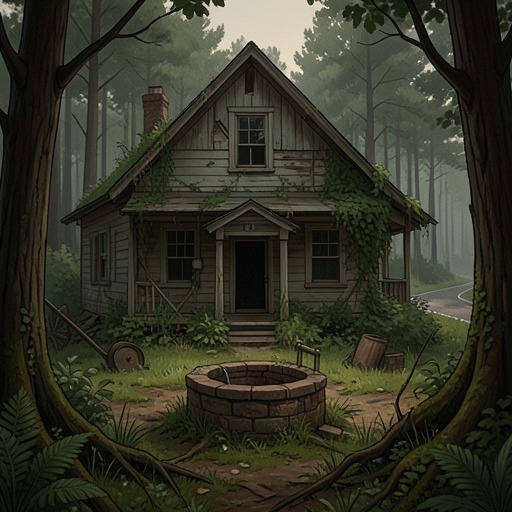
May Kasahara introduces the well after inviting Okada to see it. They cross the yard and go around the side of the house to find a circular structure about four and a half feet in diameter. Thick, shaped planks cover its opening, held in place by two concrete blocks. The curb rises about three feet, and an old fruit tree stands nearby as if keeping watch, though Okada cannot identify its kind.
The well seems abandoned along with the house, but closer inspection distinguishes its history from the surrounding neglect. It is older than the objects around it and was built in an age before the house itself. The wooden cover is an antique; a later, thick coating of concrete appears to have reinforced the original curb. The nearby tree, too, seems older than the other trees in the area. The site gathers different stretches of time around a structure whose origin remains unknown.
The Well’s Silence and Materiality
The well’s first impression is not simply that it has fallen into disuse. Okada feels that it might be called “overwhelming numbness,” and reflects that inanimate objects may become even more inanimate when people stop looking at them. The shaft makes this impression tangible: it is present and materially distinct, but its purpose and contents have receded from view.
Okada removes one of the two half-moons of the cover and leans over the curb. He cannot see the bottom; the lower part of the shaft is swallowed in darkness, and a faint moldy smell rises from it. May tells him there is no water. The well is not merely hidden from sight but emptied of the element its form promises.
To test its depth, May throws in a piece of brick. A small, dry thud comes back, with nothing after it. The sound is so desiccated that Okada imagines it could crumble in his hands. He wonders whether the well dried up or was filled in, but May points out that filling it only partway would leave a dangerous hole where someone could fall. Okada accepts that something probably caused the water to dry up; the cause remains unexplained.
Descent, Flow, and the Dark
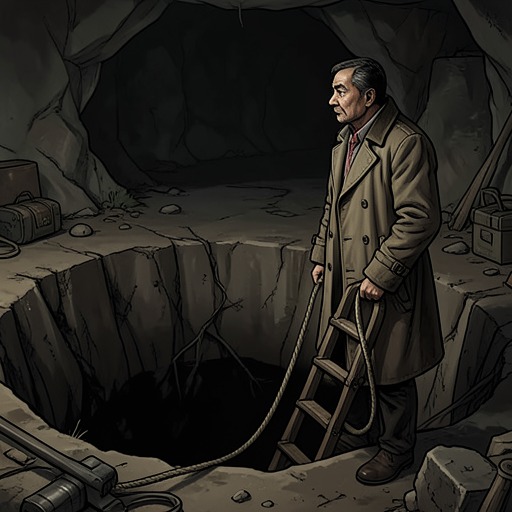
The well’s meaning is linked to Mr. Honda’s instruction that a person should go up when the flow calls for ascent, go down when it calls for descent, and remain still when there is no flow. In that counsel, a deep well is not an arbitrary image: when descent is due, one should find the deepest well and reach its bottom. Recalling the words as he stands beside the shaft, Okada recognizes that he now has a well available if he needs one.
The narration places this possibility beside a cluster of images defined by absence or obstruction: a well without water, a bird unable to fly, and an alley without an exit. The dry shaft belongs to a landscape where expected movement or function has failed. Yet it is also a potential route downward, giving the lack of water a tension with the movement Mr. Honda describes: what has gone dry may still offer a way into depth.
Okada looks into the shaft again without anticipating anything in particular. What arrests him is that such darkness exists at midday, in an ordinary place. When he clears his throat and swallows, the sound echoes as if someone else had done the same. The well thus makes depth perceptible without revealing what lies below; even a small bodily sound returns altered, as though the darkness could answer.
Narrative Significance
The well is both a specific feature of the abandoned garden and an early material counterpart to the novel’s recurring movement into darkness. Its capped opening suggests a boundary that can be lifted, while the unseen bottom withholds any assurance about what descent would mean. The dry thud, the absence of water, and the echo do not explain the shaft; they make its silence and depth more insistent.
After replacing the cover and the concrete block, Okada checks his watch: it is nearly eleven-thirty, and he needs to call Kumiko during her lunch break. The ordinary obligation follows directly after his encounter with a darkness he cannot see through. That turn leaves the well in place rather than resolving its mystery, while preserving the contrast between everyday time and the depth that waits beneath the garden.